Welcome! Join the conversation with America’s leading orchestras. Follow the blog stream below, or check out videos and podcasts from our live events in San Francisco.
What can the American orchestral world learn from major league baseball? The two industries have more in common than you might think–as Elizabeth Scott explained at our “Talking About Audiences” event last weekend.
After years as a media executive for MLB, Elizabeth Scott joined Lincoln Center last fall in the newly created role of Chief Media & Digital Officer. Here she talks with Steven Winn, American Orchestra Forum moderator and arts journalist.
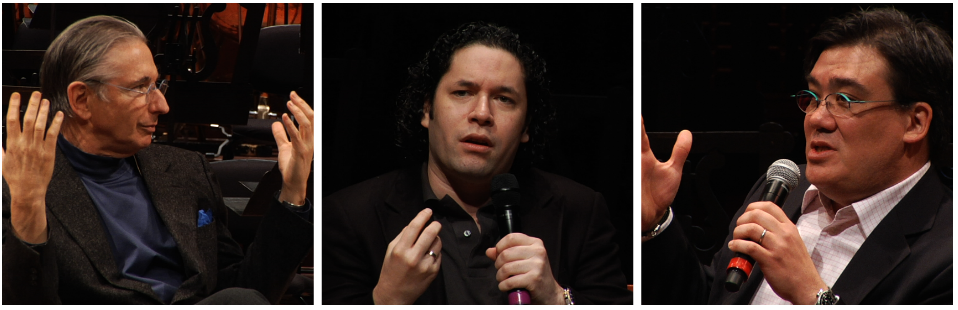
Here is the first of our videos from Sunday’s live event in San Francisco, our keynote conversation with Alan Gilbert, Music Director of the New York Philharmonic and Matthew VanBesien, Executive Director Designate of the New York Philharmonic.
Alan Gilbert says that his relationship with an audience is all about trust. It’s built over the long term, and it’s that trust that allows for exploration and risk-taking. In a world of immediate gratification, it can be hard to let go and let someone else choose what you hear and what is told to you — and it perhaps makes what happens in the concert hall even more important.
What follows is a live blog from our Talking About Audiences event in San Francisco on Sunday, May 13.
Speakers included:
Keynote: Alan Gilbert, Music Director, New York Philharmonic in conversation with Matthew VanBesien, Executive Director Designate, New York Philharmonic
Spotlight #1: Sunil Iyengar, Director of Research & Analysis, National Endowment for the Arts
Spotlight #2: Elizabeth Scott, Chief Media and Digital Officer, Lincoln Center for the Performing Arts; formerly V.P., Major League Baseball Productions
Roundtable: Spotlight speakers in conversation with Brent Assink, Executive Director, San Francisco Symphony; Matthew VanBesien, Executive Director Designate, New York Philharmonic; Mark Clague, associate professor of music, University of Michigan, and Steven Winn, San Francisco arts journalist and author
Roundtable
4:33pm Audience member: Orchestral music is a more positive experience than bull-fighting.
4:30pm Assink: Orchestras have an important role to play in getting rid of the divide between professional and amateur musician. (more…)
In a world of professional music-making, where does the devoted amateur fit in? Mark Clague—associate professor of music, University of Michigan, and co-moderator or our live event on Sunday—argues that orchestras need to work more closely with audiences who might be players themselves.
When the world’s great symphony orchestras were created 100 to 150 years ago, the strength of their audience was made up of amateur instrumentalists who knew from personal experience the transcendent joys as well as the endless struggles of making great music. This connection between performer and audience through musicianship rewarded both. Today, orchestras and orchestral musicians benefit not only by supporting K-12 music education but by reaching back to a lost tradition of amateur music making. Certainly I’d argue that amateurs have always made music, but our institutions routinely ignore their vital cultural heroics.
Web 2.0 has reminded us that communication is a two-way street. We now expect books not only to “speak” to us but to engage us in conversation. Our concept of “reader,” “listener,” and “audience” is thus shifting from (more…)
What can the American orchestral world learn from major league baseball? The two industries have more in common than you might think–as Elizabeth Scott explores in this post. After years as a media executive for MLB, she joined Lincoln Center last fall in the newly created role of Chief Media & Digital Officer. She joins us in San Francisco on Sunday, May 13 for our free Talking About Audiences event—register today!
Broadly speaking, audiences today occupy a vastly changed position in the entertainment landscape, compared to only a decade ago. In that relatively short time span, technology has enabled and encouraged audiences to be far more active in their entertainment experiences. Technology has also amplified that activity. Industries that are harnessing rather than hampering this audience empowerment stand to thrive in an ever-fractionalizing entertainment environment. As the character Billy Beane says in the film Moneyball, “Adapt or die.”
Them’s fightin’ words. But entertainment consumers wake daily to a participatory, perpetually plugged-in culture of community conversation. Multi-platformed, interactive experiences of entertainment have increasingly become an audience norm. Today’s sport fan, TV reality contest viewer, and YouTube surfer don’t necessarily have more opinions than audiences of earlier eras; they just have more immediate, more numerous and farther-reaching microphones than ever before. (more…)
Sunil Iyengar directs the Office of Research & Analysis at the National Endowment for the Arts. Since his arrival at the NEA in June 2006, the office has produced over 20 research publications and revised the major federal survey about arts participation. What does this mean for administrators, audiences, and musicians? Hard data on some of the thorny issues we think about everyday.
As we gear up for Sunday’s Talking About Audiences event, one recent NEA study certainly helps quantify a trend we’ve been exploring in the last few months—how technology is changing the orchestra’s relationship with its audience. (more…)
Where do we find audiences? In this post, Ben Cameron—Program Director for the Arts at the Doris Duke Charitable Foundation—argues that the concert hall is only one place we should be looking. Ben Cameron joins us in San Francisco on Sunday, May 13 for our free Talking About Audiences event. Register today!
How questions are framed inevitably guides and often limits our thinking. I am especially struck by the observation in this blog that “…the core orchestral presentation—a live, on-stage concert—is essentially unchanged over the past 100 years. Will that, can that, remain the case for the next 100 years?”—a “can” that seems to imply an aspiration to retain that format and an overall frame that provokes several questions of my own.
Are there reasons that the experience of the last 100 years should be definitive? (more…)
Alan Gilbert, Music Director of the New York Phiharmonic, joins us in San Francisco on Sunday, May 13 for our free event “Talking About Audiences.” Recently we had the chance to sit down with him to ask how he approaches programming and what role the audience plays in choosing what music to play. “What we do is very simple actually,” he said. “We play pieces that we really believe in, that we think are great pieces—important for the orchestra to play and important for the audience to hear.” Watch more here:
From audience engagement, music education, and a changing relationship with the community, to technology and the best use of social media… there are a lot of questions in today’s orchestral world and not always a lot of concrete answers.
Indeed, if you had to narrow it down and list just the top five things orchestras should work to change, what would they be?
In a recent talk at the University of Michigan’s American Orchestra Summit, Brent Assink, Executive Director of the San Francisco Symphony, took up that challenge in a keynote speech on the theme “What’s Working and What Must Work.” The American Orchestra Summit brought together arts administrators, educators, and musicians with the goal of inspiring “new ideas and new conversations” around such issues as productive collaboration, changing audiences and communities, and the training of the professional musician in the 21st-century.
You know the drill. Take your seat, don’t move, sit quietly, then applaud enthusiastically only at the appropriate times. Is this prescribed concert behavior the best way to engage audiences? Susan Key—special projects director for the San Francisco Symphony—examines this question.
There has been a lot of discussion lately in arts circles about the importance of listening to our audiences. For me, the point was underscored by an audience question during our March 17 Forum in San Francisco:
Sitting in the audience can be a very passive experience. I mean, my head is spinning. I have lots of thoughts going through it. But I’m not supposed to move… the expectation is that we sit. We’re well behaved. …but we’re not supposed to do anything. And I wonder whether on occasion there could be a little bit more—like in rock concerts [when] people get up and dance.
Her question brings up an issue that I think orchestras ignore at their peril: the distance between the multi-textured human experience embedded in the works on our concerts and the human behavior we prescribe for their consumption. (more…)